Well the time has come to start releasing new music once more. As you already know I’ve been toiling away on a bunch of new solo bass material here at Little Towers, trying to put together a new album to follow Mandala. As I mentioned in a previous post a couple of weeks ago, the intention was to put out a 10-track album plus a four track EP including the songs that didn’t quite fit on the record.
Well I’ve sorted the track listing for both the album (which is currently going under the title The Knowledge of Things To Come) and the EP and they both work a treat. Today I’ve been speaking to Steve Alexander (of Little Alex), who has agreed to master the EP sometime over the next week so you can expect a release announcement very soon.
This probably won’t mean much at this stage, but here’s the track listing for the Rejectamenta EP:
feel for a pulse
must get out [more]
the rhythmatist
lullabye
This will be the first release I’ve put out using my new Line 6/Looperlative setup, so I’m really excited to see what you all think of the new sounds I’m using. The music is quite different from Mandala, and sounds even less like a solo bass record. I’ve included some of the more ‘glitchy’ tracks from the sessions on the EP so you should get a good feel for what the forthcoming album will sound like. I’m going to release it exclusively via Bandcamp as a download only, using the ‘Pay What You Want’ model, ie; you can pay what you feel the music is worth to you as a listener (including for free). This is an experiment on my part really to see how that model works for niche music like mine and I’ll be blogging the results nearer the time of the album release, which should be in a few months time.
So, I shall leave you for now with a little album artwork preview. I put the cover together myself this time using the excellent free Gimp image-manipulation software, which I would heartily recommend to anyone currently engaged in such activities without the aid of a Photoshop-style safety net.
Thought I’d write a quick post after spending a couple of hours this afternoon faffing about trying to customise the custom header on my Bandcamp page with the addition of an image map.
It’s actually much easier than at first it may seem and with just a few simple steps you can have your Bandcamp page integrating with your main website in a far more effective form. The addition of a custom url for your Bandcamp page means you can use the site as a shop-window for your music which forms part of your main website as a sub-domain. This is what many artists are doing now to promote their music, using their own site as a hub and using external sites such as Bandcamp for additional functionality.
This is how I created the image map…
First you need the actual image for the custom header. I did a screen grab (command-shift-4) from the home page on my main website. Here is the crucial piece of information (which cost me two failed attempts): Bandcamp custom headers are required to be between 975 pixels wide and 40-180 pixels tall. What I should have done was check the dimensions when I did the screen grab. Third time lucky…
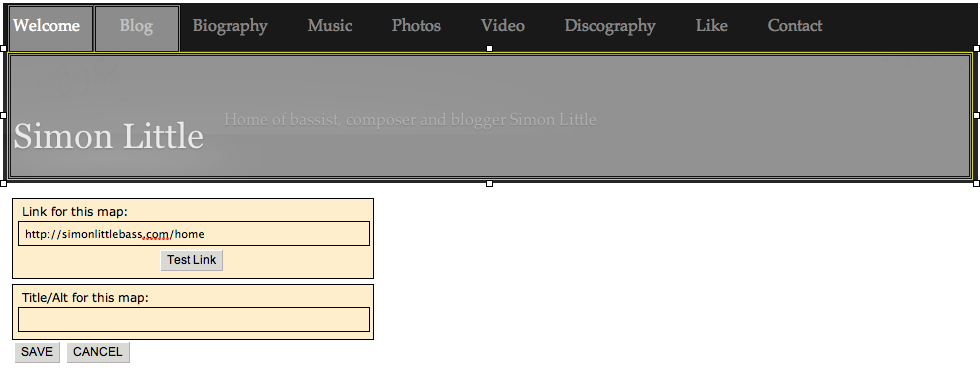
Here is what my custom header looks like. I included the menu at the top so I could superimpose the image map later…
I then went to the excellent Image Maps site and uploaded the image. I shan’t bother to fully explain how to use the site as it is incredibly easy to figure out and simple to use. Basically once the image is uploaded you can create boxes around whichever blocks you want to add links to and away you go. Starts looking a little like this:
Once you’ve finished marking up the image, just click the Get Your Code button and copy the generated HTML code to your clipboard.
Then you hop over to Bandcamp and upload your custom header image on the main page. The final step is to go to your Profile page and paste the HTML into the Use an image map box in the Custom Header section.
Then you’re laughing.
Hope that was useful to somebody. This post could’ve saved me a good hour this lunchtime 🙂
Thought it was about time I wrote a short post about this new record I’ve been working on over the last couple of months. It’s only fair…
Most of you have heard Mandala by now. Some of you might have the CD. More of you have probably got the download version from here, Amazon, or iTunes. So you know what it is that I do when playing solo. If you don’t, then click the Music tab at the top and have a listen 🙂
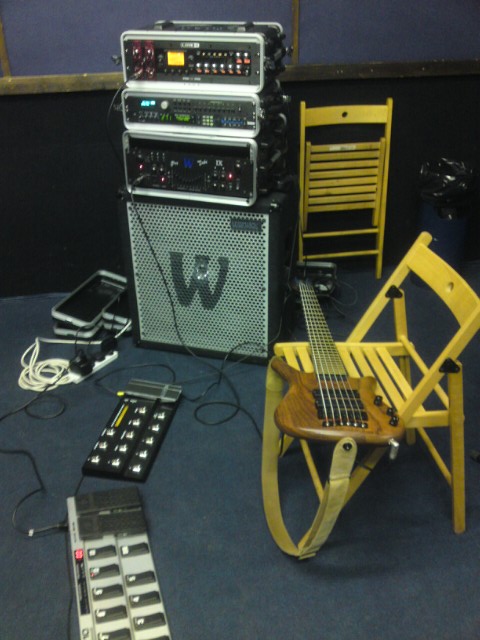
I’ve changed my setup quite a lot since Mandala. Both the live rig and the recording setup. I’ve now moved on to Pro Tools and my trusty Mbox 2 Mini; which has finally decided to start working with my LP1. The recorded sound is infinitely cleaner now and having it in Pro Tools will enable me to do so much more in post-production and will also make life a lot easier going to mastering. Just sold the old Toneport UX2 on eBay 🙂
ps. Geek Alert!! Am gonna talk about gear quite a bit here. Sorry to the Duke and TDC fans who’ve unwittingly stumbled upon a bass geek-fest…
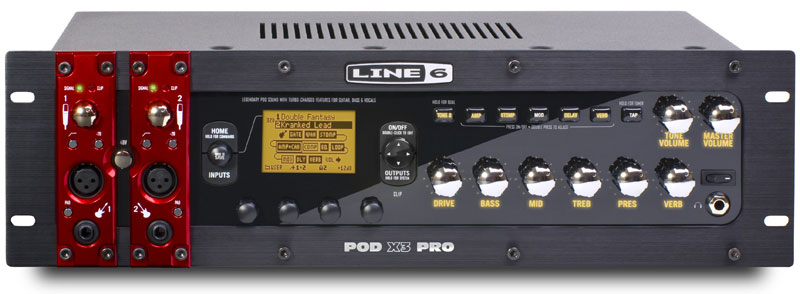
I’ve added a Pod X3 Pro and a FBV Shortboard to the live rig which has, to be perfectly frank, revolutionized the whole process for me. I used my Lexicon MPX G2 for the guitar effects on Mandala and got some great sounds. But I could never get the kind of over-processed synth effects I was really after and the UI was an incredible faff to get around; especially during a live performance. I’m still using the Lexicon in the effects loop of the X3. Couldn’t quite live without the great pitch shift effects (which are the mandolin-esque parts on Mandala) and those strange shimmering sparkly noises, but they’re used sparingly…
The Pod X3 is fantastic. The sounds I’m using now are definitely inspiring me to write new material all the time. The presets are all top notch, easily editable and programming new patches from scratch is actually a pleasurable experience rather than a chore. Adding the FBV shortboard to the mix makes it ideal for what I do with live looping; it’s like having a whole bank of complete pedalboards right in front of me. The amp modeling has also opened up the control I now have over the basic sound of the bass as I write new tunes.
So, what’s the new material like? Well, most of the tunes are more organic and less ‘written’ than those on Mandala. I’ve revisited a couple of tunes that didn’t make the last album including Baliset and Go Quietly Now (you can hear the previous ditched incarnations on my Soundcloud page). I wanted this album to be very different sonically to Mandala. I’ve used a lot more ‘guitar’ effects and synth sounds than previously, and I’ve been more precious making any actual ‘bass’ parts sound more punchy and distinct. I’ve also been a lot more experimental with the recording/performance process. I’ve been looping more glitchy sounds, crackling cables and detuned effects to further remove the music from what would obviously be solo bass.
I’ve posted it before on the blog, but here’s one of the early demos again so you have some idea (sorry about the hiss)…
So far I have ten tracks completed that I’m really happy with. I’m going to continue spending time working on new material until the tunes gel as an album. I might even release the rest of the tracks as an EP around the same time. I’m finding this new looping rig really inspiring and the recording ‘hit rate’ has been much higher than with my previous setup. I’m probably going to release this record just as a download via Bandcamp, maybe adding it to iTunes etc later on. I might be tempted into doing a very short run of limited edition CD copies (100?), but I need to find a way of making it cost effective first.
I’m really excited about this new project. It’s been great working on this alongside the Little Alex material. Having the possibility of using live drums with my looped bass in a separate project has really helped concentrate my solo writing.